Automatic packaging machines are moving toward connected controls, servo motion, machine vision, robotics, faster format changes, and lower material use. In 2024, manufacturing companies were under pressure to improve OEE while handling more SKUs with fewer operators, making flexibility as important as maximum line speed. Modern packaging cells can combine vision inspection, recipe-based settings, predictive maintenance data, and robotic handling in one control environment. A well-configured line may run above 90% availability, while automated changeovers can reduce format-switching time by 50% or more in suitable applications. Packaging automation is increasingly measured by usable production hours, reject rate, changeover minutes, energy per pack, and material consumption rather than packages per minute alone.
Packaging machinery has changed substantially since the highly mechanical lines common in the 1990s and early 2000s. Mechanical cams, shafts, chains, hand wheels, and fixed guides are increasingly supplemented or replaced by servo-controlled axes. A servo can store position, speed, acceleration, and timing parameters in a product recipe, allowing the same machine to handle several package formats without lengthy manual adjustment. On a line running 20 hours per day, removing two 30-minute manual changeovers can return about 5% of scheduled production time.
That recovered production time explains why automatic format adjustment is receiving more attention. Guides, sealing jaws, product spacing, film feed, carton dimensions, label positions, and conveyor speeds can be associated with stored recipes. An operator selects the required SKU on the HMI, and supported axes move to predefined positions. A 2025 production line handling 15 or 20 package formats can therefore use repeatable settings rather than asking operators to reproduce dozens of mechanical positions from memory.
Repeatability matters as much as speed. A five-minute changeover that produces correct packs immediately can be more useful than a three-minute changeover followed by 15 minutes of adjustment and rejected material.
Once format settings become digital, manufacturers can also record what happens during production. PLCs, servo controllers, sensors, vision equipment, and industrial PCs can collect cycle counts, stops, temperatures, pressures, motor current, reject events, and operating time. OEE is commonly separated into availability, performance, and quality; a line at 90% availability, 95% performance, and 99% quality produces an OEE of about 84.6%. Small losses that were difficult to see on older equipment become measurable.
Measurement then changes maintenance practices. Instead of replacing every component after a fixed number of months, maintenance teams can examine operating hours and condition data. A bearing may show increasing vibration, a conveyor motor may require progressively higher current, or a vacuum circuit may begin consuming more compressed air. In a facility with 25 packaging machines, preventing only one two-hour unexpected stop per machine per year removes 50 hours of lost production from the annual schedule.
Sensors alone do not predict failures, however. Useful condition monitoring requires a normal operating baseline and enough historical samples to distinguish a real mechanical change from ordinary production variation. A motor processing 100,000 cycles provides a much better reference than one observed for 100 cycles. Temperature, vibration, torque, current, pressure, and cycle-time trends can then be compared against product type, operating speed, and maintenance history rather than interpreted as isolated numbers.
| Machine data | What manufacturers can measure | Practical use |
|---|---|---|
| Servo torque | Change across 1,000+ cycles | Mechanical resistance and wear |
| Vibration | Frequency and amplitude trends | Bearing and rotating-component condition |
| Vacuum pressure | Pressure by machine cycle | Leaks, blocked filters, weak pickup |
| Seal temperature | Actual versus set point | Seal consistency |
| Vision results | Rejects per 10,000 packs | Quality trends |
| Cycle time | Milliseconds per operation | Small stops and throughput losses |
Better machine data also supports machine vision, an area where packaging automation has advanced quickly since 2020. Traditional photoelectric sensors are excellent for simple presence detection, but cameras can inspect position, orientation, print, labels, closures, seals, barcodes, and surface condition. A line processing 200 packs per minute produces 12,000 packs per hour, making manual inspection of every package impractical while giving an automated vision system a large inspection sample.
Modern vision is also being paired with machine-learning software where product appearance varies. Fixed inspection rules can struggle when acceptable products differ naturally in shape, texture, or surface pattern. A model trained with several thousand classified images can separate acceptable variation from recurring defects, although performance depends heavily on representative training data, lighting, camera position, lens selection, and validation. AI does not compensate for poor imaging conditions; stable illumination and repeatable image capture remain basic engineering requirements.
Vision becomes more useful when it controls robotic handling rather than inspection alone. Delta robots can identify randomly oriented products on a conveyor, calculate their positions, and place them into trays or packages. Six-axis robots can load cases and build pallets, while collaborative robots are used in selected lower-speed applications. Industrial robots reached a global operational stock of more than 4 million units in 2023, according to International Federation of Robotics reporting, showing how established robotic automation has become across manufacturing.
Packaging plants are applying that maturity to product handling because modern production rarely stays with one package for 10 years. A robotic cell can often accommodate another product by changing a recipe, robot path, or end-of-arm tool instead of rebuilding an entire mechanical handling section. If one cell processes 8 SKUs and mechanical conversion previously required 25 minutes per SKU change, reducing the average to 10 minutes saves 15 minutes every change.
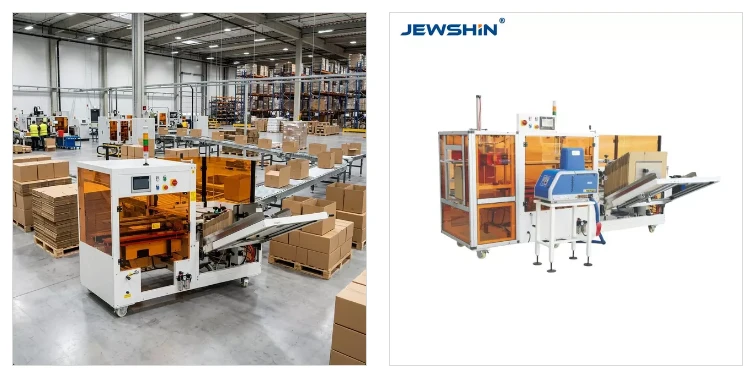
End-of-line equipment is changing for the same reason. A modern automatic carton erector can form cases continuously, fold bottom flaps, and prepare cartons for sealing or loading without requiring an operator to erect every case manually. At 12 cartons per minute, an eight-hour shift represents as many as 5,760 erected cartons before allowances for stops, changeovers, and material replenishment.
Case forming then feeds naturally into robotic case packing and palletizing. Rather than treating the carton erector, packer, sealer, labeler, and palletizer as unrelated machines, manufacturers increasingly synchronize them through line controls. If the downstream palletizer stops for 90 seconds, upstream equipment can slow or buffer products instead of continuing until conveyors fill. On lines exceeding 100 products per minute, coordinated stop and restart logic can prevent hundreds of unnecessary product movements during a single interruption.
A packaging line is limited by the interaction between machines, not by the nameplate speed of its fastest machine. A 120-pack-per-minute filler gains little from a downstream section that repeatedly stops at 90 packs per minute.
That line-level approach has encouraged wider use of industrial connectivity. OPC UA, industrial Ethernet networks, and standardized machine interfaces can pass status, alarms, production counts, recipes, and quality information between equipment. A plant operating 10 lines across three shifts can compare stop frequency, average changeover duration, rejects per 10,000 units, and output per scheduled hour without relying on handwritten shift reports.
Remote diagnostics have expanded alongside connectivity, particularly since 2020, when travel restrictions made remote technical support more important for global machinery suppliers. Authorized technicians can review PLC alarms, HMI logs, servo status, or machine parameters without immediately traveling to the site. A fault resolved remotely in two hours instead of waiting 24 hours for on-site support can return almost a full production day, although network access must be controlled and recorded.
Cybersecurity therefore becomes part of packaging engineering rather than an office IT issue. Connected machines should use individual accounts, controlled remote-access permissions, backups, network segmentation, and documented software versions. A plant commissioning equipment in 2026 may expect the machine to operate for 10 to 20 years, far longer than the normal support cycle of many computers, making software maintenance and access management relevant throughout the equipment's working life.
Long machine lifetimes are also encouraging virtual commissioning. Engineers can create digital representations of conveyors, robots, servo axes, sensors, and control sequences before physical commissioning. PLC logic can be checked against simulated machine behavior, while robot paths can be reviewed for reach and collision issues. Finding a sequence error during a digital test involving 1,000 simulated cycles is generally less disruptive than discovering it during customer production.
Digital models are particularly useful when machines have many interacting axes. A high-speed wrapper, cartoner, or case packer may coordinate dozens of motion events within a cycle measured in hundreds of milliseconds. Simulation lets engineers inspect timing before hardware is fully available and can shorten on-site debugging. The same model can later assist with a new package size introduced in 2027 or 2028.
Material changes create another reason to preserve that flexibility. Brand owners are reducing packaging weight, testing recyclable mono-material films, introducing paper-based formats, and reducing unnecessary secondary packaging. A 10% reduction in film thickness can change stiffness, stretching behavior, heat transfer, and web handling, so a machine calibrated for an older laminate may require different tension, temperature, pressure, and sealing time.
Modern equipment addresses those differences through closed-loop controls. Film tension can be measured continuously, servo feeds can correct registration, and temperature controllers can maintain sealing conditions within narrow operating ranges. Suppose a line uses 1,000 kg of film each month: a 3% reduction in startup and registration waste saves 30 kg monthly, or 360 kg over 12 months, without changing the finished package design.
Material savings also depend on dosing accuracy. Filling 2% more product than specified may appear small on one package, but the scale changes quickly across millions of units. For 5 million 500-gram packages, a persistent 2% overfill represents 50,000 kg of additional product. Accurate filling equipment, checkweighers, feedback controls, and regular calibration therefore connect packaging automation with both quality control and resource use.
Energy measurement is developing in a similar direction. Packaging machines consume electricity through motors, heaters, vacuum pumps, controls, and auxiliary equipment, while pneumatic devices add compressed-air demand. Rather than comparing only monthly utility bills, plants can monitor electricity or air per 1,000 packages. If a modification reduces energy consumption from 18 kWh to 16 kWh per 1,000 units, the reduction is about 11.1%.
Compressed air deserves close measurement because leaks and excessive pressure can remain unnoticed while production continues. Electric actuators and servo mechanisms are replacing pneumatics in some repetitive applications, although pneumatic cylinders remain practical for many simple movements. A 2026 equipment specification is therefore more likely to include utility-consumption information alongside output, footprint, and package-size range than a specification written 15 years earlier.
Traceability adds another layer to machine specifications. Pharmaceutical, medical, food, and high-value consumer-product lines may combine printers, laser markers, barcode readers, cameras, and databases. At 150 packages per minute, a line creates 9,000 inspection opportunities every hour. Automated code verification can check presence and readability at production speed while removing failed packages through a controlled reject station.
Serialization goes further by assigning individual identifiers rather than only batch information. Unit codes can be associated with cartons, cases, and pallets, creating records across several packaging levels. A case containing 24 serialized units and a pallet containing 40 cases represents 960 unit-level records associated with one pallet configuration, placing much greater importance on reliable data exchange between printers, cameras, controllers, and production databases.
As machine functions increase, operator interfaces have to become easier rather than more complicated. HMIs are moving from pages filled with raw numerical parameters toward role-based screens, guided setup, alarm histories, maintenance instructions, and recipe management. A plant with three shifts and 12 operators cannot depend on one experienced technician remembering every adjustment, especially when a line contains 30 or more controlled axes.
Training tools are developing around the same requirement. Digital manuals, HMI animations, QR-linked service information, and augmented-reality support can show where a component is located and how a maintenance procedure should be performed. If a guided procedure reduces a recurring 20-minute adjustment to 12 minutes, five occurrences per week recover about 35 hours across a 52-week production year.
The remaining engineering trend is modular construction. Feeding, forming, filling, sealing, inspection, labeling, case packing, and palletizing can be arranged as replaceable or expandable machine sections. A manufacturer buying equipment in 2026 may not know which package will be introduced in 2030, so mechanical space, software capacity, network interfaces, and control architecture increasingly need room for later additions.
A useful machine specification therefore compares more than nominal speed. Manufacturers can examine OEE at realistic product conditions, average changeover minutes, rejects per 10,000 packages, mean time between stops, utility consumption per 1,000 packs, supported material ranges, remote-service controls, spare-part availability, and expansion options. A machine rated at 200 packs per minute but operating at 70% effective output can produce less usable volume than a 170-pack-per-minute system sustaining 90% effective output, which is why current packaging investment is increasingly evaluated with production data rather than headline speed alone.