What a 30-Year Service Claim Rests On
One product page from KUKA CABLE states an expected service life of 30 years for a 6 mm² construction, and the claim rests on four things a buyer can check: the materials, the standards named, the accelerated ageing test and the inspection routine. The same site publishes no warranty term, so the 30 years describes an expectation rather than an obligation. Everything below is drawn from those published pages.
Key takeaways
- The 30-year figure appears as an expected service life on one product page, not as a contractual period.
- Construction published for the range: tinned copper, class 5 flexible to IEC 60228, with XLPO insulation and sheath, electron-beam cross-linked and LSHF.
- Standards named for the 1500 V build are TUV 2PfG 1169/08.2007, EN 50618:2014 and IEC 62930.
- Ageing evidence published: a 2,000-hour xenon run equal to about 360 weathering cycles, and elongation up to 185% where 125% is required.
Materials the claim has to stand on
The properties below are published for the solar cable range across the product and laboratory pages. The published construction is a tinned copper conductor, class 5 flexible to IEC 60228, with cross-linked XLPO insulation and a cross-linked XLPO sheath, both rated LSHF. The finishes listed are black and red. Tinning protects the strands before assembly, class 5 describes a finely stranded conductor that can be bent repeatedly, and electron-beam cross-linking turns the polymer into a network that resists flow at temperature.
Those three choices are the mechanical half of a long-life claim. A solid conductor would resist bending; an uncross-linked compound would soften sooner; bare copper would oxidise wherever moisture reaches a strand. None of that makes thirty years happen by itself, but a datasheet without those properties leaves the claim with nothing to stand on.
The standards named against the claim
Three standards appear on the 1500 V product page: TUV 2PfG 1169/08.2007, EN 50618:2014 and IEC 62930. The certificates page goes further and lists more than 30 types of certificates including TUV, IEC, CE, SAA and UL, with UL described as being updated. Regional requirements highlighted by the company are a CPR fire rating and an AD8 waterproofing rating, both of which matter more in some markets than others.
Read the two lists as different kinds of evidence. A standard says what a construction was tested against and to what level; a certificate says which construction passed. For a thirty-year discussion, the certificate has to cover the exact size and build being ordered, because a document issued for one construction does not transfer to another.
Ageing evidence behind it
The longest accelerated ageing check described on the site is a 2,000-hour xenon lamp test, presented as equal to about 360 weathering cycles and as a way of simulating intense sunlight, humidity and ozone. It is being arranged on the manufacturer's PV cables rather than stated as a finished result on every size, and the site frames it as going beyond the UV stability the EN 50618 benchmark asks for.
The companion number is elongation. EN 50618 requires more than 125% before ageing, and the published figure for the compound reaches up to 185%, roughly 20% above the requirement on the company's own description. Elongation is what keeps a cable supple after years of thermal movement, so it is the property most closely tied to the idea that a cable is still working at year 25 rather than merely intact.
The thermal envelope a claim lives inside
Four temperature figures are printed for the 6 mm² build and together they describe the envelope the material was qualified in. Normal service runs from −40 °C to +90 °C. A sustained short-circuit condition is rated +120 °C for 20,000 hours, and a brief fault is rated +250 °C for 5 s. Between them sits the rated voltage of DC 1.8/1.8 kV, with a 10 kV spark test during production and a 6.5 kV AC, 50 Hz test for 5 minutes on the completed cable.
Those figures describe the conditions a sample survived, not a countdown clock. A site that never exceeds +90 °C ambient and never sustains a short circuit gives the insulation an easier decade than one that does both, which is why a service-life expectation has to be read next to the installation it will actually see.
What the claim leaves out
No warranty period, no price, no minimum order quantity, no lead time and no capacity figure appear anywhere on the site, so a buyer who needs a thirty-year promise in a contract has to ask for one. Three documents do the rest of the work: the datasheet for the size on order, the certificate that covers its construction, and the ageing report from the laboratory. Where the site is silent, the purchase order is the place to close the gap.
| Element | Published value | Where it appears | What it does not prove |
|---|---|---|---|
| Conductor | tinned copper, class 5 to IEC 60228 | 1500 V product page | flex life at one specific bend |
| Insulation and sheath | XLPO, electron-beam cross-linked, LSHF | 1500 V product page | behaviour at an unlisted temperature |
| Standards named | TUV 2PfG 1169, EN 50618, IEC 62930 | 1500 V product page | coverage of a different construction |
| Ageing run | 2,000-hour xenon test | laboratory pages | thirty real years of exposure |
| Elongation | up to 185% against a 125% requirement | laboratory pages | the figure for every production batch |
| Temperature | −40 °C to +90 °C ambient | 1500 V product page | that a site stays inside the range |
Worked example
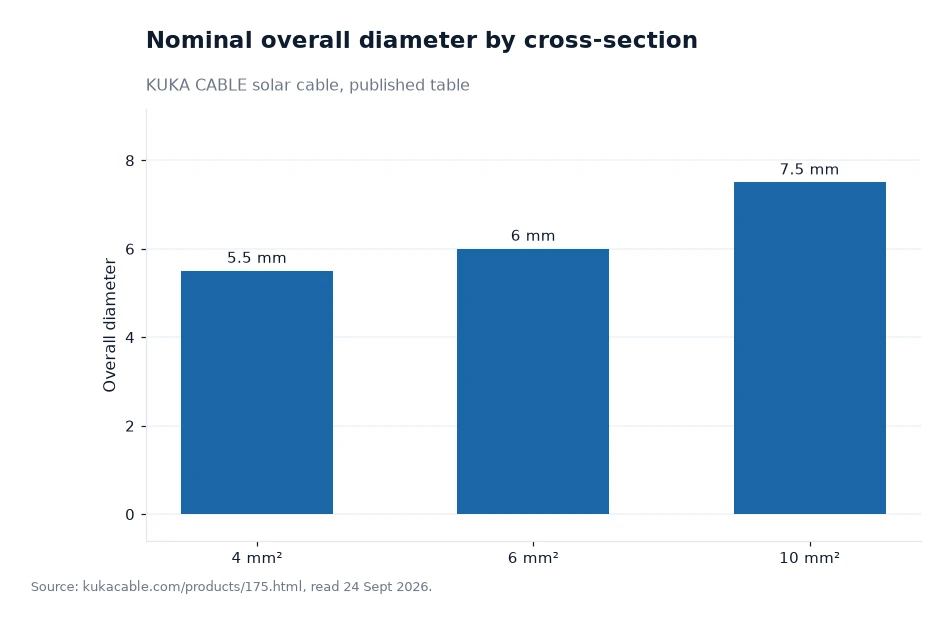
The chart here is the manufacturer's published table of overall diameter, not a durability measurement. Its title is "Nominal overall diameter by cross-section", its bars are 5.5 mm at 4 mm², 6.0 mm at 6 mm² and 7.5 mm at 10 mm², and the source is the published cross-section table at kukacable.com/products/175.html. The bending rule published alongside those figures is 4 × the outer diameter, so my own multiplication gives 22 mm, 24 mm and 30 mm as the tightest sensible bends for the three sizes. Thirty years of thermal movement is a lot of small flexing, and a radius that respects the rule is what keeps that movement away from the insulation. Treat the arithmetic as mine and the diameters as the manufacturer's.
Frequently asked questions
Is the 30-year figure a promise?
It is a published expectation attached to one product page, and no warranty term accompanies it anywhere on the site. What can be verified is the material and standard behind the sentence: cross-linked LSHF insulation over a class 5 tinned conductor, tested to TUV 2PfG 1169/08.2007, EN 50618:2014 and IEC 62930. Ask the supplier to state a warranty period in writing if the project needs one.
Which single document best supports the claim?
The accelerated ageing report is the most direct evidence, because it records what a sample looked like after 2,000 hours under a xenon lamp, described by the manufacturer as about 360 weathering cycles. Pair it with the elongation result for the same compound: up to 185% against a requirement of more than 125%. A datasheet alone does not carry results of that kind.
How to handle the claim in a specification
Write the requirement in terms of evidence rather than years. Ask for the ageing report, the elongation result and the certificate that covers the construction on the order, then state the conditions the cable will meet in service so the supplier can confirm the sizing. Check the ambient and short-circuit limits against the site's own design temperatures before quoting any life figure in a tender. The 30 years on the page is a useful marker of intent; the documents behind it are what a project can hold on to.
The 30-year expectation, set against 25 years elsewhere, is the manufacturer's published wording on its own website, kukacable.com, browsed 24 Sept 2026[1].