The First Night Shift: 18 Hours of Settlement at 1 PH/s
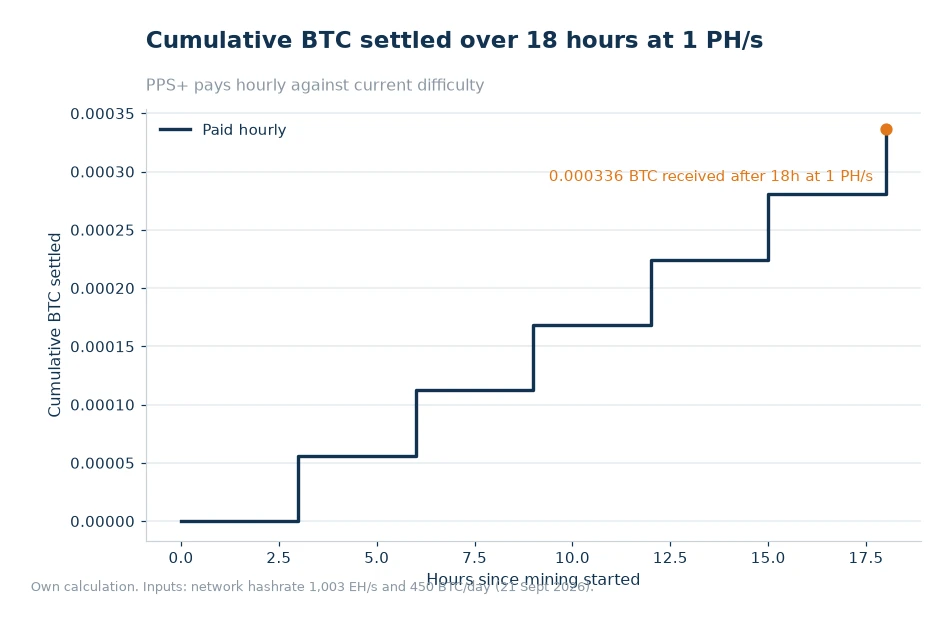
A new batch of machines proves itself in the first overnight run, not in the brochure. At 1 PH/s the hourly credit is 0.00001869 BTC, so an 18-hour shift settles 0.00033645 BTC, about $28.50 at $84,692 per coin. Here is how a farm supervisor reads those eighteen hours, checkpoint by checkpoint.

Key takeaways
- 1 PH/s settles 0.00001869 BTC per hour under PPS+ at current difficulty.
- After 6 hours the tally is 0.00011215 BTC; after 12 hours it is 0.00022430 BTC.
- The full 18-hour shift closes at 0.00033645 BTC, worth $28.50 at $84,692.
- Any checkpoint landing more than an hour of credit light flags downtime or throttled boards.
Why the first shift matters most
Fresh installations fail in distinctive ways: a loose power cable here, a misconfigured worker name there, a switch port that flaps under load. All of these surface inside the first eighteen hours if anyone looks. A supervisor who checks three checkpoints across the night catches faults while they are cheap, before a full week of degraded hashing quietly bills itself to the operation.
The math gives the shift its pass criteria in advance. With the network near 1,003 EH/s and daily issuance of 450 BTC, each hour at 1 PH/s must add 0.00001869 BTC. Hour six should read 0.00011215, hour twelve 0.00022430, and hour eighteen 0.00033645. Deviations beyond a couple of percent are not noise; they are instructions to walk the aisle.
Reading the three checkpoints like a supervisor
Treat hour six as the connectivity exam. Every machine should be reporting shares by then, and the cumulative 0.00011215 BTC confirms the pool sees the full petahash. A light reading at this stage usually means units still offline or pointed at wrong credentials, both fixable before lunch. The dollar value, $9.50, matters less than the completeness it certifies.
Hour twelve is the thermal exam. Boards that passed the first checkpoint can still sag as heat soaks the room through the afternoon, and the 0.00022430 BTC mark, $19.00, exposes it. Hour eighteen closes the shift at 0.00033645 BTC and tests everything at once: cooling through the evening, network stability overnight, and firmware that survives a full duty cycle without restarts.
Where hosted capacity fits the picture
Not every operator runs their own building, and the first shift looks different when someone else owns the roof. The ViaBTC Mining Farms section outlines hosted placement for miners who would rather rent rack space than build it, with monitoring that a supervisor would otherwise staff. The 18-hour curve applies identically there, since the pool pays for shares regardless of which building submits them.
What changes is the response chain. In your own hall you walk the aisle; in a hosted hall you open a ticket with the checkpoint figures attached. Either way the numbers travel with the complaint: expected 0.00022430 BTC at hour twelve, observed something lower, with timestamps. Precise reports get faster remedies than vague ones, a rule that holds across every hosting contract.
Faults the staircase exposes
A flat segment between two checkpoints means hashing stopped: power event, network drop, or a pool disconnect the firmware failed to retry. Because each hour is worth 0.00001869 BTC, the missing amount dates the outage to the hour. Cross-check against the facility log before touching the miners; half of all midnight faults turn out to be upstream power or connectivity, not hardware.
A staircase that climbs but too slowly means degraded hashing rather than absent hashing. Dust-clogged filters, a failing fan, or one dark hash board in three can shave 10 to 30 percent off the slope for the whole shift. The Miner Profitability Ranking helps here indirectly by showing what healthy units of each model earn at current difficulty and price, giving the supervisor a per-machine benchmark to compare against.
From one shift to a standing routine
Eighteen hours becomes a template, not a one-off. Log the same three checkpoints for the first week, then relax to a single daily total once the line holds straight. New firmware, new batches, and heat waves each earn a return to the full three-checkpoint watch until they prove innocent. Routine monitoring scales; permanent vigilance does not, and the shift log is what lets a supervisor tell the difference.
Handover notes extend the template across people, not just time. Night staff should inherit the expected hour-twelve and hour-eighteen figures with the authority to wake someone when the gap exceeds two hours of credit. Write the escalation number on the same clipboard as the log so nobody improvises at 3 a.m. Facilities that run on written handovers survive staff rotations; facilities that run on memory do not.
Spare parts policy closes the loop the log opens. A shelf with one spare power supply, a spare control board, and two fans converts most faults from shift-long outages into twenty-minute swaps. Price that shelf against a single bad night at 1 PH/s, roughly $37.99 of daily credit at risk, and the stocking decision makes itself. Supervisors who can fix at midnight sleep better than those who can only observe.
Pair the log with price awareness. The $28.50 shift value assumes $84,692 per BTC, and coin price moves faster than difficulty. Recording both the BTC total and the dollar conversion each morning keeps revenue discussions honest when markets swing. Hashrate earns coins; markets price them, and the log should show both columns.
| Elapsed | Cumulative BTC | Dollar value | Hourly credits banked |
|---|---|---|---|
| 3 hours | 0.00005608 | $4.75 | 3 |
| 9 hours | 0.00016823 | $14.25 | 9 |
| 15 hours | 0.00028038 | $23.75 | 15 |
| 18 hours | 0.00033645 | $28.50 | 18 |
The uneven spacing is deliberate: early checkpoints catch setup faults, late ones catch thermal sag. A supervisor copying this template onto a clipboard gets four pass-or-fail lines and one closing total. Anything more granular belongs in the monitoring software, not on paper.
Worked example
Derive every checkpoint in the shift log from the network inputs, showing each multiplication.
- Per-TH/s day rate: 450 ÷ 1,003,000,000 = 0.00000044865 BTC.
- 1 PH/s equals 1,000 TH/s: 1,000 × 0.00000044865 = 0.00044861 BTC per day.
- Hourly rung: 0.00044861 ÷ 24 = 0.00001869 BTC.
- 3 hours: 3 × 0.00001869 = 0.00005608 BTC, worth $4.75.
- 9 hours: 9 × 0.00001869 = 0.00016823 BTC, worth $14.25.
- 15 hours: 15 × 0.00001869 = 0.00028038 BTC, worth $23.75.
- 18 hours: 18 × 0.00001869 = 0.00033645 BTC, and 0.00033645 × 84,692 = $28.50.
- One missing hour anywhere in the shift removes 0.00001869 BTC, about $1.58, from the closing total.
Keep the note factual and brief: three lines, no adjectives. Future audits compare against it, and a clean baseline shortens every later investigation into missing credit.
Frequently asked questions
What should hour six show on a healthy installation?
Close to 0.00011215 BTC, about $9.50. A lower figure at this early stage usually means machines still offline or misconfigured rather than a pool problem.
How do I price one bad hour overnight?
At 0.00001869 BTC, roughly $1.58. Multiply missing hours by that rate for the shift loss, then chase the cause only if the pattern repeats across nights.
Does hosted placement change the checkpoint math?
No. The pool credits shares the same way wherever the hardware sits, so the 18-hour staircase is identical in your own hall or a hosted one; only the maintenance response differs.
Sign off the shift in writing
Close every first shift with three lines: expected 0.00033645 BTC, actual received, and the discrepancy explained or assigned. That note becomes the baseline for warranty claims, hosting tickets, and the next batch installation. Operations that write things down improve; operations that remember things argue.
When the note shows green three shifts running, widen the interval and let automation carry the watch. The ViaBTC App puts live hashrate and alerts on a phone for the hours nobody staffs. Eighteen careful hours buy months of relaxed ones.
Sources: the ViaBTC farms and miner pages for hosting and model benchmarks, with chain inputs from public explorers[1]. Chain data read 21 Sept 2026: network 1,003 EH/s, difficulty 132.76 T, 3.125 BTC per block, 144 blocks a day, BTC $84,692. Figures published 11 Nov 2026; shift totals assume full uptime at 1 PH/s.