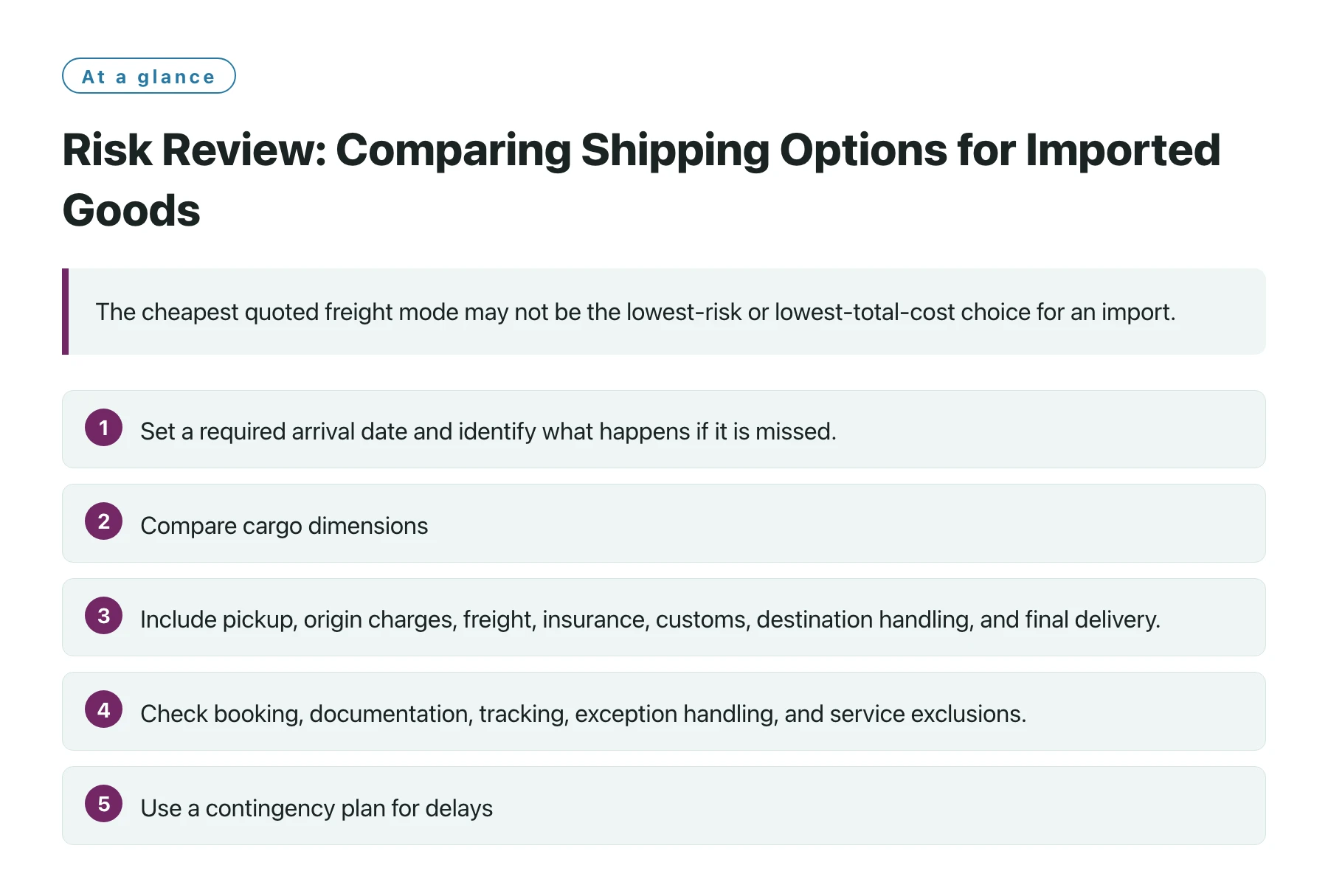
The cheapest quoted freight mode may not be the lowest-risk or lowest-total-cost choice for an import. Buyers should compare cargo readiness, size and weight, required arrival date, handling sensitivity, customs process, insurance, destination fees, and delivery access. A route decision works best when it starts with the shipment’s purpose and constraints, then tests the assumptions behind each carrier and service quote.
Key takeaways
- Set a required arrival date and identify what happens if it is missed.
- Compare cargo dimensions, weight, handling needs, and route suitability across modes.
- Include pickup, origin charges, freight, insurance, customs, destination handling, and final delivery.
- Check booking, documentation, tracking, exception handling, and service exclusions.
- Use a contingency plan for delays, holds, damage, and changes in cargo readiness.
Compare the same origin, destination, package data, cargo, service level, and delivery point before evaluating price.
Define the shipment’s purpose and constraints
Record the cargo, supplier, origin location, destination, quantity, dimensions, gross weight, packaging, and earliest ready date. Identify the required arrival date and the operational consequence of a delay. A launch deadline, construction sequence, replenishment need, and sample review can justify different service choices even for similar products.
List handling conditions: fragility, moisture sensitivity, temperature range if specified, orientation, stacking limits, dangerous-goods classification if applicable, and security needs. Obtain those conditions from the product owner. A standard freight quote may exclude special handling, controlled equipment, or additional documentation.
Importers evaluating Learn more about shipping support should begin with a complete cargo brief. Ask each forwarder or carrier to confirm which mode, service, and named delivery point the price covers.
Compare transit patterns and schedule reliability
Air freight typically uses a different capacity, cost, and handoff structure from ocean freight, while courier and multimodal services may combine additional pickup or delivery steps. Compare the actual service being offered, including collection, export processing, terminal handling, linehaul, customs clearance, and final delivery. Do not compare a port-to-port quote with a door-to-door service as if they were equivalent.
Ask for scheduled transit ranges, cutoff dates, sailing or flight frequency, transshipment points, and recent route constraints from the provider. A headline transit time may begin after cargo acceptance and document completion. Work backward from delivery and include supplier readiness, pickup, consolidation, export clearance, and customs processing.
Separate planned time from buffer. For critical cargo, model a delay scenario and identify the consequence of missing the delivery date. If a faster route costs more, compare the cost against the value of earlier availability and the risk of a production or sales interruption. Avoid treating a carrier’s estimate as a guaranteed arrival.
Normalize total costs to one delivery point
Ask for itemized costs for pickup, origin handling, consolidation, export clearance, main freight, insurance, destination handling, customs brokerage, duties or taxes where relevant, storage, inspection, and final delivery. Identify which charges are included, estimated, variable, or billed later. Use the same delivery point and service scope for every option.
Check how freight is calculated from package dimensions, weight, pallet pattern, volume, density, and special handling. Reconfirm when final cartons differ from the quote. Ask about fuel, peak-season, security, remote-area, waiting-time, demurrage, or detention charges where applicable. Use the forwarder’s current written assumptions rather than a previous shipment’s invoice.
State the delivery term and exact named place in the sales contract. The U.S. International Trade Administration explains that Incoterms allocate defined seller and buyer tasks, costs, and risks, including transport, insurance, documentation, and customs work. [1] The chosen rule does not automatically include every service or destination cost; list uncovered items separately.
Match the mode to cargo characteristics
Review dimensions and weight against aircraft, container, courier, truck, or warehouse limits. Oversized, unusually heavy, fragile, or restricted cargo may require special equipment, packing, or a different route. Ask the carrier to confirm acceptance requirements before production is complete, particularly if a product includes batteries, liquids, magnets, chemicals, or other regulated components.
Consider handling count and transfer points. A service with fewer handoffs may reduce exposure to rehandling, but the effect depends on route and provider execution. For delicate goods, ask what packaging and handling instructions are required and which damage evidence should be recorded at each transfer.
For perishable, temperature-controlled, or medically sensitive goods, rely on the product owner’s requirements and a qualified logistics provider’s written service capability. Confirm monitoring, packaging validation, excursion handling, and record retention. Do not assume standard air or ocean service preserves conditions merely because transit time is short.
Review customs and documentation readiness
Confirm commercial invoice, packing list, origin details, transport document, product records, permits, or other information required for the destination. Match product descriptions, parties, quantities, values, and package counts across documents. A broker should review classification, valuation, origin, and destination-specific declarations using current requirements.
Ask who transmits the customs entry, who answers queries, and which documents must be available before departure or arrival. Some data must be submitted before cargo reaches a destination. Missing or inconsistent details can trigger holds, storage charges, or a change in delivery date. Include document deadlines in the mode comparison because faster freight cannot compensate for an unready customs file.
Clarify how samples, replacement goods, repairs, or returns will be declared. Their customs treatment may differ from a commercial sale. Obtain professional guidance for the specific transaction rather than copying a prior invoice description.
Assess carrier, insurance, and exception response
Check provider identity, subcontractors, tracking detail, customer service hours, claims route, and service exclusions. Ask what happens after missed connections, port congestion, weather disruption, customs holds, or cargo damage. Record escalation contacts and how the provider communicates revised arrival estimates.
Review cargo insurance separately from carrier liability. Confirm insured value, covered risks, deductibles, exclusions, claims deadlines, evidence requirements, and whether packaging conditions affect coverage. A carrier’s limited liability terms are not necessarily equivalent to insurance. The buyer’s risk or finance owner should review the option against cargo value and contractual obligations.
Evaluate warehouse and destination handling. Confirm storage capacity, receipt confirmation, cargo segregation, appointment availability, unloading equipment, and final-mile access. Ask whether a provider can hold, re-route, or return cargo and what additional charges apply. Include an alternate route or escalation path for urgent or high-value shipments.
Compare consolidation, split shipments, and inventory impact
A consolidated shipment may combine orders to share a booking, but can wait for the latest supplier, add warehouse handling, or increase the complexity of customs and receipt records. A split shipment may deliver urgent goods sooner while creating repeated charges and separate documents. Compare the actual ready dates, cargo dimensions, quantities, and receiving needs.
Determine which goods can be combined under the same handling, customs, and delivery plan. Keep lots, suppliers, and purchase orders identifiable. If items have different storage conditions or regulatory status, ask a qualified professional whether consolidation is appropriate. Never let a full container plan obscure the release status of one supplier’s goods.
Include inventory consequences in the comparison. Earlier delivery may require storage, working capital, or more receiving capacity; later delivery may risk stockout or installation delay. Ask operations and finance to define the relevant cost of time, not just freight price.
Use a decision matrix with explicit assumptions
Create one row per option and columns for end-to-end transit estimate, cutoff, pickup scope, freight, origin and destination charges, insurance, customs support, delivery point, cargo restrictions, tracking, service exclusions, and contingency. Mark unknowns and identify who will verify them. A matrix helps reveal gaps that a single quoted total can hide.
Set project priorities before scoring: required arrival, total cost, cargo risk, documentation complexity, predictability, and receiving constraints. Apply any hard constraints first, such as mandatory handling or fixed event dates. Do not average away a mode’s failure to meet a critical requirement.
Save quote date, validity, package assumptions, route, and service terms with the decision. Reconfirm before booking if cargo, timing, or market conditions change. A comparison is only valid for the shipment data on which it was based.
Prepare the shipment and review actual results
Before booking, confirm cargo release, final dimensions, packaging, labels, documents, pickup location, delivery appointment, insurance choice, and consignee availability. Tell the supplier and carrier which party can authorize charges or route changes. Keep the chosen plan and fallback visible to operations and finance.
Track pickup, export handoff, departure, arrival, customs release, and final delivery. Record exceptions, package condition, and custody transfers. At receiving, reconcile counts, identifiers, and damage against the packing list and purchase order. Preserve photographs and packaging where a claim may depend on them.
After delivery, compare actual time, cost, condition, and service response with the quotation. Separate carrier, supplier, customs, buyer, and external causes. Use evidence from the shipment to improve future route selection and packaging requirements, without assuming every route or season will behave the same way.
Sources
Frequently asked questions
Is air freight always faster door to door than ocean freight?
Not necessarily. Compare ready dates, pickup, export processing, transit, customs, destination handling, and final delivery for the actual services quoted.
What costs should I compare besides freight?
Compare pickup, origin handling, freight, insurance, customs, duties, destination charges, storage, unloading, final delivery, and any special handling or inspection fees.
Does an Incoterm tell me the full shipping price?
No. It allocates defined tasks, costs, and risks between seller and buyer. Provider fees, destination charges, and uncovered services still need separate pricing.
When should a shipment mode be selected?
Select a mode after cargo, final dimensions, readiness, destination, arrival date, handling needs, customs documents, and named delivery point are confirmed.