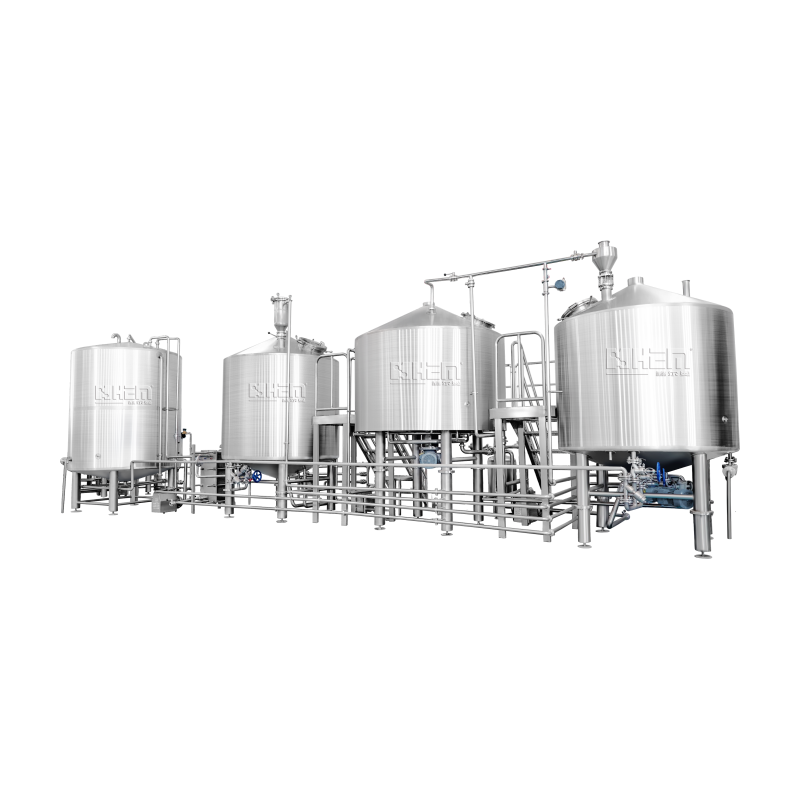
Choosing brewery equipment starts with annual output, batch size, tank occupancy, packaging format, and available utilities. A brewery targeting 5,000 barrels per year with a 10-barrel brewhouse needs roughly 500 finished batches before losses, while a 5% process loss raises the required brewed volume above 5,250 barrels. Fermentation time matters just as much: beer held for 14 days uses half the cellar time of beer held for 28 days. Floor space, steam or electrical capacity, glycol cooling, drainage, pressure ratings, labor hours, and future tank additions should be calculated before purchase. Capacity only works when the brewhouse, cellar, utilities, and packaging line are sized together.
Start with saleable beer rather than the advertised brewhouse volume. A 15-barrel brewhouse does not automatically produce 15 barrels of packaged beer from every turn. Trub, transfer residue, dry-hop absorption, filtration, carbonation work, and packaging losses reduce output; a brewery using a planning loss of 5% would need about 15.8 barrels of wort to finish 15 barrels of saleable beer. A 10,000-barrel annual sales plan at the same 5% allowance therefore requires more than 10,500 barrels upstream.
That production number can then be converted into brewhouse turns. At 20 barrels per turn, 10,500 barrels requires about 525 turns a year; across 250 brewing days, that averages 2.1 turns per day. A two-vessel brewhouse can handle that schedule in many operations, but a brewery expecting 4 or 5 turns per day may need separate mash, lauter, kettle, and whirlpool vessels so one batch can move forward while the next starts.
A larger brewhouse reduces the number of turns, but it does not shorten fermentation. A 40-barrel batch occupying a tank for 21 days still uses 840 barrel-days of cellar capacity.
Fermenters therefore deserve more attention than the brewhouse alone. If a 20-barrel brewery sends one batch each day into a fermenter and the average beer occupies the vessel for 18 days, at least 18 batch-sized tank positions are needed before allowing time for cleaning, maintenance, yeast collection, delayed releases, or seasonal products. Adding a 10% scheduling allowance pushes the practical requirement closer to 20 tank positions.
Tank size changes the math. Two 20-barrel brews can feed one 40-barrel fermenter, reducing the number of individual tanks, valves, manways, sensors, and cleaning cycles. The tradeoff is flexibility: losing access to one 40-barrel tank removes twice the batch capacity of a 20-barrel vessel, while a taproom selling 12 rotating beers may find several smaller tanks easier to schedule than four or five large vessels.
| Production item | Example specification | What to check |
|---|---|---|
| Annual finished beer | 10,000 bbl | Include 3–8% process and packaging loss allowance |
| Brewhouse | 20 bbl | Turns per day and realistic cycle time |
| Fermentation | 14–28 days | Product mix and tank occupancy |
| Cellar allowance | 10–15% | Cleaning, maintenance, schedule changes |
| Expansion space | 20–30% | Future fermenters, piping, access aisles |
Tank construction should then be checked beyond nominal volume. 304 stainless steel is commonly used for brewery product-contact equipment because it handles normal brewing conditions well and can be cleaned repeatedly. 316L may be specified where chemical exposure or the operating environment justifies greater corrosion resistance, but using it throughout a brewery can raise equipment cost without improving beer output by 1%.
Working volume and total volume also need separate figures. A fermenter sold as a 30-barrel vessel may have 30 barrels of working capacity plus additional headspace, or the quoted figure may refer to total geometric volume. Fermentation foam and dry hopping need room above the liquid level, so buyers should request both numbers rather than assuming a tank marked “30 bbl” accepts a full 30-barrel batch under every recipe.
Pressure specification becomes more important once carbonation, spunding, pressure transfer, or unitank operation is planned. Brewers Association guidance published in 2026 states that brewing process vessels operating above 15 psi generally need to follow ASME pressure-vessel requirements, while non-ASME vessels need pressure protection appropriate to their rating. A tank intended for 15 psi service should never be treated as interchangeable with equipment engineered for higher pressure.
Cooling capacity follows tank selection. Fermentation produces heat, while crash cooling can require much more refrigeration over a shorter period. A cellar with ten fermenters may operate normally when one tank is crashing, then struggle when 30% of the cellar is commanded to drop from fermentation temperature to cold-conditioning temperature at once. Chiller selection should therefore use simultaneous demand, glycol supply temperature, ambient temperature, pipe length, jacket area, and pump flow rather than total tank volume alone.
The Brewers Association has also advised breweries to avoid crashing multiple tanks at the same time when refrigeration capacity is limited and to inspect glycol concentration, reservoir level, insulation, pumps, and condenser condition. Its 2026 guidance specifically recommends USP-grade propylene glycol for brewery cooling systems.
A useful equipment review can compare the following points before purchase:
-
Calculate peak cooling with at least 2 or 3 tanks entering high-demand cooling stages together.
-
Check whether glycol pumps can maintain design flow at the longest piping run.
-
Leave practical connection capacity for 20–30% more cellar volume where expansion is planned.
-
Confirm jacket placement on both the cylindrical body and cone where the fermentation process requires it.
-
Ask for design ambient conditions; a condenser sized around 80°F weather may behave differently during 100°F summer operation.
Heating needs the same system-level check. A 5-barrel electric brewhouse may fit comfortably within a small production room, while a 30-barrel electrically heated system can require substantial three-phase service. Steam becomes more common as output rises because one boiler can serve kettles, hot-liquor equipment, and other thermal loads, but boiler sizing, condensate return, water treatment, ventilation, piping, inspections, and maintenance all become part of the installed cost.
For that reason, compare commercial brewery equipment using utility requirements as well as purchase price. A brewhouse quoted at 20% less than another option can lose that advantage if the building requires a major electrical-service upgrade, larger gas line, new boiler room, or additional roof penetrations before the first batch is produced.
Water supply can create a similar mismatch. Brewing, vessel rinsing, CIP, floor cleaning, packaging, and boiler makeup can create demand at the same time. If a brewery wants to produce 40 barrels of beer in one day, the total water entering the building can be several times the finished beer volume once cleaning and process uses are included. Exact consumption depends on brewery design and operating practice, so the equipment vendor should supply flow requirements rather than only daily estimates.
Drain capacity should be checked at peak discharge, not average daily use. Emptying a 10-barrel rinse volume in 10 minutes places a very different demand on a floor drain than releasing the same volume across 2 hours. Floor slope, trench size, drain position, wastewater temperature, solids handling, and local discharge requirements belong on the facility drawing before tanks are installed.
Packaging becomes the next capacity check because filling speed is often quoted as a maximum mechanical rate. A canning line rated at 40 cans per minute could theoretically process 2,400 cans per hour, but cleaning, material loading, seam checks, product changes, stoppages, warm-up, and end-of-run procedures reduce actual shift output. Planning around 100% nameplate speed usually creates a packaging schedule that cannot be maintained.
A brewery filling twelve 12-ounce cans per case would theoretically make 200 cases per hour at 40 cans per minute. At 70% effective running time, output drops to roughly 140 cases per hour. An 8-hour production day then produces about 1,120 cases before additional constraints such as labeling, date coding, tray packing, pallet movement, or beer availability are considered.
Packaging equipment should match cellar release volume. A filler capable of processing a week of finished beer in 4 hours may cost more, occupy more floor space, and require more operators without increasing annual production.
The same review applies to kegging. A small brewery filling 100 kegs a week may operate efficiently with a compact washer-filler, while production of 500 or 1,000 kegs per week changes labor, cleaning, staging, compressed-air, CO₂, and material-handling requirements. Keg size also affects throughput: fifty 1/2-barrel kegs contain the same nominal beer volume as one hundred 1/4-barrel kegs, but require twice as many individual handling and connection cycles.
Automation should then be selected around repetitive work rather than equipment appearance. Automatic temperature control on 20 fermenters removes hundreds of manual adjustments over a 2026 production year, while variable-frequency drives allow pumps to serve several flow requirements without relying only on throttling valves. Automated valves, flowmeters, level instruments, recipe control, and CIP sequencing can reduce operator handling, but every sensor and actuator also adds calibration, spare-parts, electrical, and software support requirements.
Maintenance access deserves physical measurement before approving the layout. A tank that fits under a 16-foot ceiling may still be difficult to install if the rigging process needs additional vertical clearance. A 48-inch manway can be accessible on a drawing yet difficult to service if another vessel leaves only 18 inches of working space beside it. Pumps, heat exchangers, valves, motors, spray devices, and instrumentation all need room for removal, not merely enough room to operate.
Before ordering, compare supplier quotations line by line rather than comparing only total price:
| Check | Supplier information worth requesting |
|---|---|
| Vessel capacity | Working and total volume |
| Material | 304 or 316L by component |
| Pressure | MAWP, relief setting, applicable code |
| Cooling | Jacket area and design duty |
| Electrical | Voltage, phase, frequency, connected load |
| Pumps | Flow, head, motor size, seal type |
| Controls | PLC, HMI, sensors, remote support |
| Documentation | Drawings, manuals, wiring, parts lists |
| Warranty | Duration, exclusions, labor and freight terms |
| Support | Commissioning, training, parts availability |
Expansion should be designed into the infrastructure without buying several years of unused stainless steel. A brewery expecting production to move from 5,000 to 8,000 barrels within 3 years can leave cellar floor space, spare glycol headers, electrical panel capacity, drainage connections, and control I/O for future tanks. Reserving 20–30% physical and utility capacity is often easier than relocating operating fermenters after the cellar is full.
The final purchase check is therefore numerical: annual barrels, turns per day, average tank days, tank count, packaging hours, cooling demand, water flow, electrical service, steam demand, compressed air, CO₂, drainage, staffing, and planned expansion year. When those figures agree with each other, a brewery can compare equipment on construction quality, service access, controls, documentation, supplier support, and total installed cost instead of buying capacity that another part of the plant cannot use.